The Difference Between a Rough Patch and a Real Problem in Your Marriage
When Is It Time for Therapy?
Knowing When to Reach Out for Therapy Isn't Always Clear
It can be hard to know when it's time to seek support. When does disconnection actually begin? Is there a moment when it suddenly becomes a problem?
According to John Gottman, founder of The Gottman Institute, couples wait an average of six years before seeking therapy. In my experience as a couples therapist in Chino Hills, the disconnection often begins long before that. It just lives under the surface.
When Was Your First Disillusionment in Your Relationship?
One question I often ask on my intake (developed by Ellyn Bader, founder of The Couples Institute) is: "When was your first disillusionment in the relationship?"
The first disillusionment is the moment when the dream of who you hoped your partner would be collides with the reality of who they actually are.
This question helps me understand an important potential pattern for the couple. How will they handle further disillusionments?
Relationships develop in stages. Symbiosis is the first stage. This is the stage of falling in love where we feel that sense of a "soul mate." This stage lasts for about two years. Next, we move into the stage of differentiation, where we come to the realization that we are truly different.
In the stage of differentiation, partners learn to stay steady in a strong sense of self while staying emotionally connected to each other. Partners learn to stop trying to change one another and respect differences and learn to negotiate with maturity and flexibility.
This is where that first disillusionment pattern can take root.
Here, couples either resolve the disillusionment through healthy differentiation practices.
Listening to each other
Expressing concerns or thoughts that are different from their partner's
Controlling reactivity in the face of differences
Negotiating solutions
Couples who struggle with differentiation often find it showing up in other areas of their relationship too. If that sounds familiar, my blog on codependency may be worth a read.
OR the couple gets stuck in arguing, blaming, reactivity, or avoidance. Either way, this is where the initial pattern begins to take place.
When disillusionment isn't worked through, it doesn't disappear. It becomes part of the pattern. Over time, that pattern can shape how you communicate, how you fight, and how connected you feel.
Disconnection rarely happens all at once. It builds slowly, through unresolved moments moments that were never fully repaired.

What Is Your Conflict Pattern?
A question I ask when meeting with a couple for the first time is: "Tell me about how conflict is handled. Who does what?" Followed by more questions like: "And then what happens?"
Couples follow predictable patterns. Do any of these sound familiar?
Simply avoiding conflict. There is no conflict at all. This may leave the couple confused about their disconnection. If there is no conflict, partners are likely not showing up authentically. Conflict is inherently part of relationships. No conflict, no vitality.
Arguing, blaming, raising voices, then shutting down into silence.
One partner brings up a concern and the other avoids the topic. This results in frustration for the partner who wants to address it.
A classic pursue-withdraw pattern. One partner pursues in reaction to their anxiety and the other withdraws. The more one pursues, the more the other withdraws. And around and around it goes. Exhausting, right?
Understanding your cycle is one of the first steps toward breaking it. You can also read more about how to make up after a fight with your partner for tools to begin shifting the pattern.
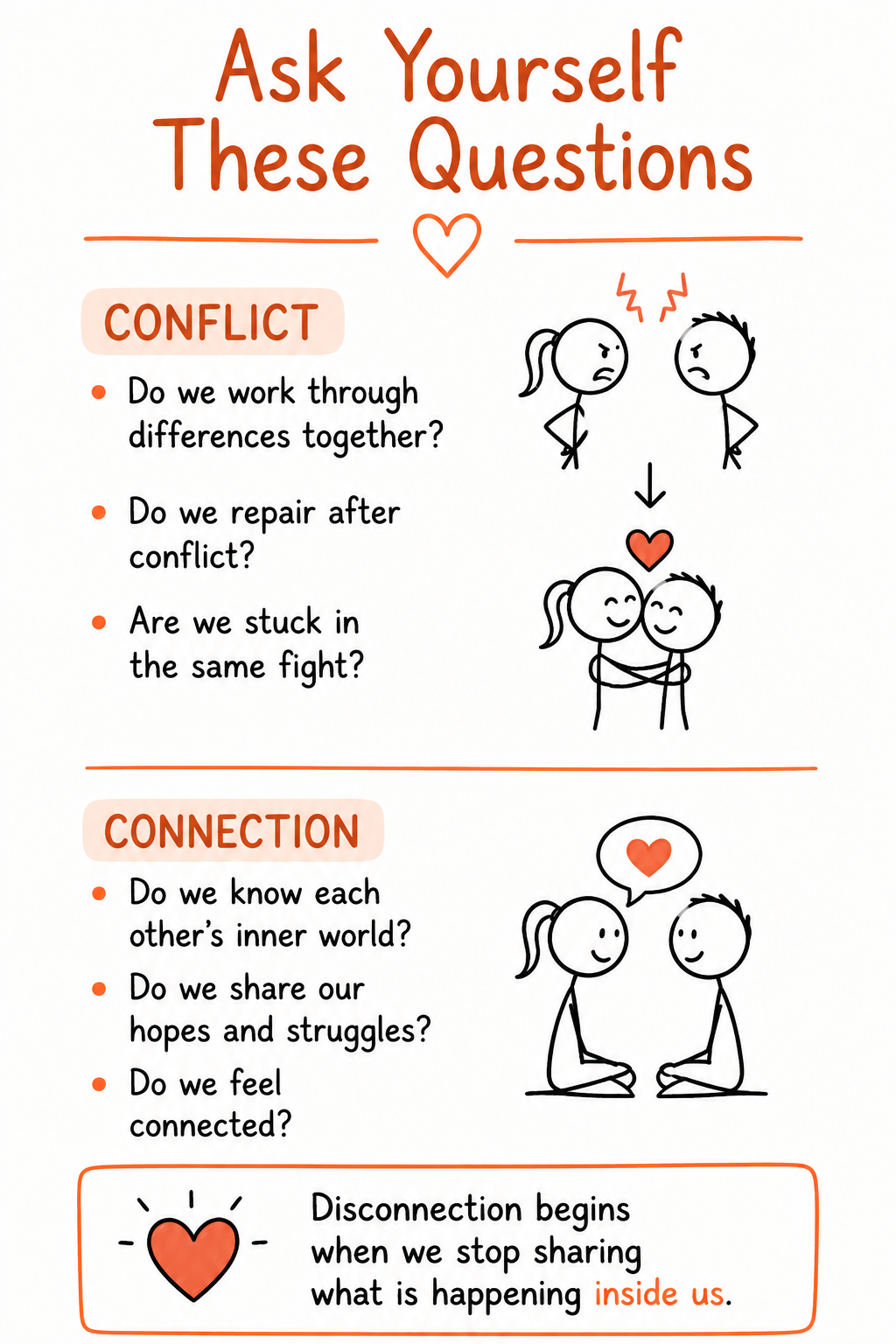
So How Do You Know: Is This a Rough Patch or Something More?
Ask yourself these questions:
About conflict:
Are we moving through conflict and differences while staying connected? Is there healthy repair after a rupture?
Are we stuck in a repeated pattern of conflict that leaves us feeling alone?
Is there a pattern of not resolving conflict and simply sweeping it under the rug?
Are we fighting, bickering, or arguing about differences? Do we get reactive about differences?
About connection:
Do I feel like I understand my partner's inner world?
Does my partner understand my inner world?
Do we have conversations that keep us connected about our dreams, hopes, desires, and wishes?
Do we share openly about our hurts and struggles?
Disconnection happens when we stop sharing what is happening inside us, not just around and between us.
And then there's the newfound companionship of AI replacing real intimacy and connection. But that’s a whole separate blog post.
A Metaphor: Strings of Christmas Lights
Many years ago when I was decorating for Christmas, I pulled out our Christmas lights to hang them up. They were completely tangled. The year before, I hadn't taken the time to put them away carefully. Five kids, post-holiday cleanup, everything rushed. You get the picture.
As I untangled the lights, I remember thinking: this is what happens in relationships when things don't get tended to along the way.
If I had slowed down, untangled them, and wrapped them neatly (even around a simple piece of cardboard), that would have saved so much time and frustration later.
Relationships can work the same way.
When couples don't address disconnection as it begins to build, when things are pushed aside, left unresolved, or become a consistent source of hostile arguments, things don't just disappear. They build on each other. Before the couple knows it, what started as a small knot becomes a tangled mess.
And the longer it's left, the more time, care, and intention it takes to untangle.
Untangling the Lights: This Is Where Hope Begins
One of the most effective ways to do this is through a couples intensive in Chino Hills.
Here are the benefits of intensive couples therapy:
Dedicated time to truly focus on your relationship. Life is extremely busy. An intensive is a time to slow down, reflect, and focus on the relationship that matters most, even when life's hectic pace keeps pushing it aside.
Move beyond talking into experiencing real change. This isn't just about discussing problems. You'll actively practice new ways of communicating, understanding, and relating to each other in real time.
Understand the patterns that keep you stuck. I will work with you and your partner to not only understand the cycle, but more importantly how to exit the cycle.
Slow things down so you can actually hear and feel each other. Instead of reactive conversations that escalate or shut down, we create space for deeper understanding and meaningful connection.
Accelerated learning and growth. What might take months in weekly therapy can begin to shift in a matter of hours when we have uninterrupted time to stay with the process.
A customized plan designed specifically for you as a couple. Through many years of dedicated work, I thoughtfully tailor the intensive to meet the unique needs of your relationship.
A proven process that supports real, lasting change. This work is grounded in methods that have helped many couples move from disconnection to clarity, understanding, and renewed connection.
Opportunity to repair past hurts while changing present patterns. We work together through unresolved issues, while I teach you tools to show up differently moving forward.
Envision and begin creating a different future together. You won't just understand what's been happening. You'll begin to experience what's possible and build toward the kind of relationship you both want.
Leave with tools, insight, and a clear path forward. You walk away not only feeling more connected, but with practical ways to continue the work beyond the intensive.
Want to learn more about what this process actually looks like? Read more about what intensive couples therapy involves.
If you are ready to untangle the lights and are looking for marriage counseling in Chino, CA or couples counseling near me in the Chino Hills area, I would love to connect. Reach out today and let's begin.

How to Get Started
Scheduling an intensive with me, a couples therapist, is simple:
Reach out to schedule a consultation
Complete questionnaires to help tailor your intensive
Work collaboratively with me to set your couples intesive schedule
Schedule a follow-up session at my therapy practice